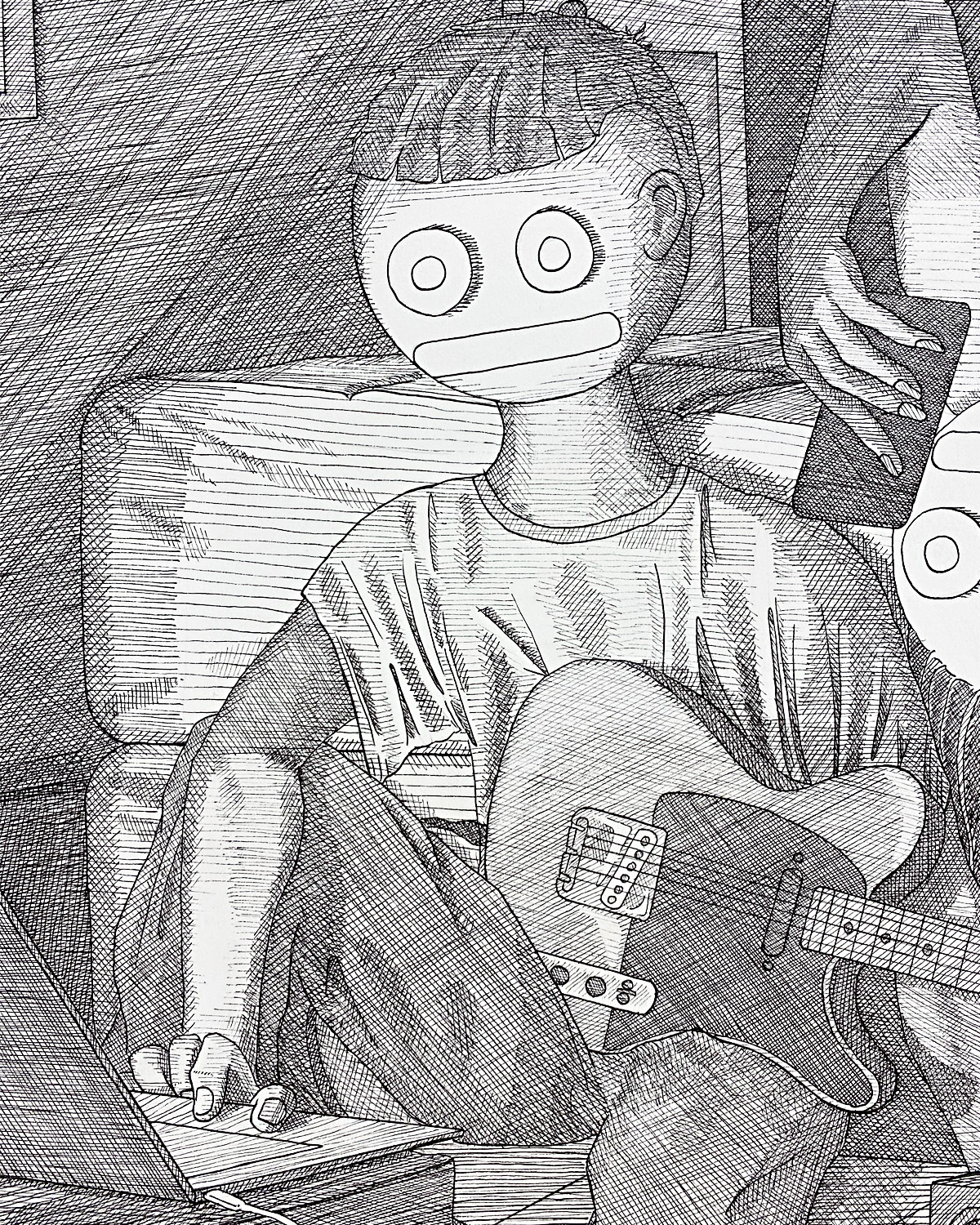


Misfits abound in Cowboy Poet, Simon Fuh’s exhibition at YYZ Artists’ Outlet, which features a collection of seven ambitious pen drawings and one text work. Each of the drawings was created during the first year of Fuh’s return to his hometown, Regina, after six years in Toronto. During this first twelve months back, while getting his bearings and simultaneously revisiting memories from his adolescence, he began drawing figures and landscapes as a way of reconnecting with the city.
All of the pen drawings present hyper-detailed black-and-white scenes of debauchery and violence. Some are banal, such as Grecian Summer, which shows a picnic gone wrong as two friends, a man and a woman, hoist up the limp body of a third person, who, judging by the empty wine bottle on the blanket behind them, has passed out from drinking. At the other end of the spectrum, All of Us Trying to Get Struck by Lightning is a bacchanal of madness in which a pyramid of tangled bodies clamber over one another in lashing rain, reaching desperately toward the sky. At first glance I could make out only four individual figures and assumed they were perched on some central structure such as a tree or telephone pole. On closer inspection, however, I realized there is no underlying support: the four figures are piled atop others, whose outstretched arms yank at errant ponytails or clutch at the collars of T-shirts. Presumably, they all struggle in order to better position themselves toward their apparent goal of being struck by lightning.
I say “misfits abound” because these people are not engaged in what one might call dignified or conventional behaviour. Choice moments from other drawings include one man hurling a beer bottle at another in the parking lot of a dingy walk-up apartment building, and a man sliding his elongated tongue between the breasts of his uninterested partner as she scrolls through her phone, her head hanging dispassionately off the edge of their shared bed. In that same image, titled Band Practice, another figure sits inches away from the unhappy couple, slouched casually on the floor before an open MacBook, a Telecaster guitar limp in his lap.
The crudeness of these moments is contrasted with Fuh’s accomplished rendering, which captures each scene in dense, cross-hatched detail. What is perhaps more surprising, given the subject matter, is that Fuh describes his compositions as “Baroque,” a term typically reserved for the visual art, architecture, and music that dominated Europe between the seventeenth and mid-eighteenth centuries.
While Baroque visual art encompassed a diverse group of styles, emerging first in Rome and spreading throughout Italy, Spain, the Netherlands, and beyond, it is generally united by its focus on climactic moments of drama rendered in rich detail.[1] Two of the best-known artists associated with the movement are Caravaggio and Rembrandt, both celebrated for their masterful use of chiaroscuro, the dramatic interplay of light and shadow.[2] Fuh’s drawings echo this approach through their dense tonal contrasts and theatrical staging. While I was initially surprised to encounter references to a post-Renaissance art movement in work that otherwise felt so contemporary, considering Fuh’s interest in the Baroque ultimately enhanced my viewing of the drawings.
For example, the glow emanating from two screens—a MacBook in the lower left corner of Band Practice and a phone in its centre—becomes evocative of the beam of light in perhaps one of the most well-known Baroque paintings of all time, The Calling of Saint Matthew by Caravaggio. This work depicts the biblical scene when the tax collector Matthew is first called by Jesus to become a disciple. In Caravaggio’s composition, Matthew and his companions sit in a dim tavern while a shaft of light enters from outside the frame, illuminating their faces and signalling both divine presence and spiritual awakening.[3]
In Fuh’s composition, his subjects are in a darkened room, but the light illuminating their inhumanly ovoid faces is not natural brightness streaming from a window. Instead, it’s a digital glow emanating from their screens. It strikes them from below rather than above, and instead of prompting spiritual awakening it seems to distract them from the task at hand. The would-be guitarist is too absorbed in the laptop to engage in the act of making music, while the woman on the bed appears so engrossed in her phone that she barely acknowledges the insistent presence leaning over her. This light is not so much a call to action but instead an alienating force.
Another element evoking the Baroque is Fuh’s frequent use of diagonal compositions, particularly evident in Pop Pop’s Grandkid Hit a Deer, where scenes from parking lots and football stadiums collide. Baroque compositional strategies often relied on diagonals to heighten a sense of motion, instability, and drama. Fuh pushes this sense of instability even further through the placement of the drawings themselves on the page. Rather than extending to the edge of each sheet, the images sit within white borders resembling those of an instant photograph. However, unlike instant photographs where the developed image runs parallel to the border, Fuh’s borders are slightly off-centre. This subtle misalignment, more pronounced in some drawings than others, lends the scenes a fluid, unsettled quality.
But what, in the end, do these choices point toward? In the canonical Baroque paintings such as The Calling of Saint Matthew, the emotions expressed through gesture and posture are mirrored in figures’ faces, which crystallize the drama of each scene. This is one aspect that Fuh has pointedly refused by giving each of his subjects vaguely mechanical features: oversized circular beads as heads, each with identical blank eyes and rectilinear mouths. This choice, according to Fuh, is partly to keep their identities ambiguous. Even though the figures and scenarios are drawn from his memory, he prefers them to remain unstable.[4]
This approach is reminiscent of Brenda Draney, an Edmonton-born painter who also works from memory. Draney frequently leaves areas of blank space within her canvases, believing that these gaps allow viewers to complete the scene themselves and thus become active participants in the image.[5] Perhaps Fuh’s decision to leave his figures’ identities similarly open-ended makes them more accessible to us as viewers, whether by inviting identification with his subjects or by prompting memories of similar scenes passing before us.
One central intention behind Baroque image-making was the desire to inspire awe. In Rome, where the movement first flourished, Baroque painting was supported by wealthy patrons and the Church in an effort to “make Rome the most beautiful city in the Christian world, for the greater glory of God.”[6] Through their dynamic compositions, stark contrasts of light and dark, and theatrical intensity, these images invited viewers to imagine themselves seen by a higher power and admired by fellow observers.
We may not be as religious a society as seventeenth-century Rome, but the desire to be seen by some greater power remains familiar. As a Canadian who often feels dwarfed by the US due to its massive media presence both in Canada and globally, I sometimes imagine that higher power as a global audience. Do people in major cultural centres such as New York City, London, or Berlin spend as much time thinking about Toronto as Toronto spends thinking about them? I somehow doubt it.
Recently, while attending a screening and Q&A for the film Nirvanna the Band the Show the Movie, director and star Matt Johnson spoke about touring the film across the United States and hearing young Americans express excitement about visiting Toronto. For him, this was deeply gratifying: he had grown up rarely hearing such sentiments from Americans. The local crowd responded enthusiastically, cheering him on and thanking him for putting Toronto on the radar.
I bring this up not to obscure the fact that Fuh’s work centers on Regina, but to suggest that a similarly conflicted desire for recognition might be present in his drawings. Many artists in Canada and elsewhere hope to show the world how they live and where they come from. Perhaps not for the greater glory of God, but for the glory of recognition.
Fuh’s drawings do not present an idealized vision of Regina, but they revel in dramatizing aspects of everyday life there, often pushing them to the point of absurdity. Like Johnson’s fictional scheme (spoilers) to be struck by lightning in order to execute a time-travel plot, Fuh’s attempt to court lightning seems to have succeeded. We see him; we see Regina. The lightning here is not divine recognition. It is the gaze of the world, and I, for one, want to see more.
[1] Janson, H.W., “History of Art: Third Edition” (New York, Harry N. Abrams, 1986), 500.
[2] LeBourdais, George Philip, “The Most Iconic Artists of the Baroque, from Caravaggio to Rembrandt” (Artsy.net, 2016) <https://www.artsy.net/article/artsy-editorial-these-masters-of-the-baroque-painted-dramatic-scenes-of-spiritual-revelation>
[3] Ibid.
[4] Ibid.
[5] Mileaf, Janine. Vesely, Carolyn.“Foreword” in Brenda Draney: Drink From the River, ed. Adelina Vlas, Jacqueline Kok (Berlin, Hatje Cantz, 2023), 7.
[6] Janson, “History of Art”, 500.
CIAR O’MAHONY is a curator based in TKaranto. They are a member of collectively run gallery the plumb, and co-direct independent gallery SCaM. Variously, they have exhibited work, developed public programs, and curated exhibitions for South London Gallery, UK, The Goldsmiths Centre for Contemporary Art, UK, Cubitt Artists’, UK, the plumb gallery, TKaranto, The Aird Gallery, TKaranto, and Archer Beach Haus, US. Their work is carried by Art Metropole (TKaranto) and archived by Xpace (Tkaranto.) They have been published by e-flux journal, Eater, Liminul Magazine, Blackwood Gallery, and The Power Plant Contemporary Art Gallery. For more information, visit ciaromahony.space.
They would like to thank Simon Fuh and YYZ Artists’ Outlet for the writing opportunity, and Joshua Rogin and Niamh O’Laoghaire for their editorial support.