

The Set-up: OCA, Punk, YYZ
I came to Toronto in 1974 when I turned eighteen. I wanted to be downtown and to go to art school. At OCA I studied photography, painting, video, Marshall McLuhan’s media theory, and Michael Snow’s work. This was in the ‘photoelectric art’ program, a legacy of Roy Ascott’s progressive interdisciplinary pedagogy introduced a few years earlier.(i)
At the time, the economy was in recession and there was an abundance of urban space in any big North American city. In New York, LA or Detroit, whole downtown neighborhoods were literally abandoned. In Toronto, they were only forsaken figuratively, at the end of every workday.
There were several billion less people in the world then, far fewer collectors, curators, writers, dealers and consultants—and artists too. Consequently there was less to do and having fewer things to do made it easier to find people who were interested in the same things. Everyone who was interested in something showed up to it and since so few people were there, you got to know each other. The only art audience was other artists.
Gentrification hadn’t been invented yet. You could still rent an empty loft without the landlord knowing you intended to live there. Artists were invisible, and if no one is paying attention to what you are doing, they don’t stop you from doing things. Turn an empty space into a gallery or bar, a theater, restaurant, or drug den—whatever you prefer. No need for a business plan, or loan, or license, only paint, clamp-on lights, and extension cords—and a bathtub to ice the beer you’d sell to pay the rent.
It was simpler to get things going. If you lived in New York and wanted to show your work, you started P.S.1 or the New Museum. If you wanted a place to eat, you started Food like Gordon Matta-Clark in Soho. Want to let people know about your art ideas? Start Avalanche, The Fox, or Punk. If you lived in Toronto, you started: A Space, Art Metropole, File, Impulse, Peter Pan, Queen Mother, or the Subway Room.
The easiest and only way to get anything done was to do everything yourself, or with friends who were interested in the same things. There was a gang of interested people for every place that was started, then more people once they saw what was happening. Some collaborations had official names like The Red Brigades, or the Bader-Mienhof Gang. My first collaboration gang was the band The Diodes in 1976.(ii)
In 1979, a different gang of us met in the art college lunchroom. We already knew that since we were about to graduate, we had better start a gallery so that we would have a place to show our work. To have our own thing was preferable to having to use earlier. To have our own thing was preferable to having to use someone else’s. We called our thing YYZ.(iii)
Making Monumenta
In the late summer of 1982, Madonna was mixing her first single and Michael Jackson was recording Thriller. I was busy organizing YYZ Monumenta with Stan Denniston, Brian Groombridge and Bernie Miller, the season opener at the gallery. I’m sure the exhibition grew out of a joke about not going to see Documenta that year, and to make our own version instead. We had the resources to do it and the rationale seemed self- evident: all the young artists were finding ways not to do what they were expected to do.
Since we knew it wouldn’t be done otherwise, we felt we needed to do it. I was confident that I understood what I saw around me. I was part of it. I was idealistic and optimistic, so other people would get it too. All boats float on a rising tide.
Stan, Brian, Bernie and I worked on Monumenta all July and August. (One newspaper later reported that it was ‘two weeks’ but we were kidding around when we said that.) We met frequently over beers in the evenings to compare notes and consolidate a list of artists. Other YYZ members suggested artists as well. It didn’t take long to put together an initial roster. We started with ourselves and added other local artists we thought interesting and wanted to show with. We talked, crossed off duplications or names that didn’t seem to fit, tried others and so on. Why someone fit was what the show was meant to discover. We couldn’t yet say why, but we could say whom. We visited a lot of artists that summer and if our interests coincided we would ask them for more names. In a way the show was self-selecting(iv)
The interesting aspect of remembering is to find myself in a past before certain ideas became familiar, before those ideas became a fundamental way for people to think about art. The ideas, debates and politics attached to the word ‘representation’ were still in the future that summer. Many people spent the next few decades coming up with new words and ideas about representation, but all that came afterward. In Toronto the process started with Monumenta. A new art needed new words to describe it, new values to appreciate it and new people to look at it. Starting with Monumenta, non- specialists and super-specialist could both talk. Post-Monumenta, people who thought about Toronto art had to change their expectation about what Toronto art was, how it was made, and if it was worth caring about. As we chose our artists that summer, we were all still Pre-Monumenta. We had to intuit the differences; no one had ever worked them out before.
At that time discussion of contemporary art in Toronto seemed largely centered on work shown by the David Mirvish Gallery, an ongoing education in ‘Post-painterly Abstraction.’ Mirvish was on the inside track of an international circuit of galleries who promoted Olitzki, Poons, Frankenthaler, Noland, Bush, et al. A decidedly more conceptual and minimal school of abstraction that included local artists Ric Evans, and Jaan Poldaas was centered on Mercer Union.(v)also seemed associated with distinctive critical interests. YYZ had photo- conceptualism, appropriation, feminism; A Space was more literary and performance oriented; up on Spadina, ChromaZone showed figurative, gestural, sort of punk, painting.
This last gang was a problem. ChromaZone started after YYZ and while it didn’t seem to have a very solid gallery space, the artists involved had an anarchistic energy and a well-defined aesthetic. The painting was definitely ‘not abstract’, and therefore contemporary, but to us it lacked a crucial criticality and ideology. It appeared to be a restaging of art historical conventions, untroubled clichés and popular myths of avant- garde angst. We expected the future to be modern, and art history to be a conveyor belt of cultural innovation. Rather than excluding ChromaZone’s neo-expressionist painterly painting, my co-curators and I agreed on a foolproof strategy. We would put them in the show, thinking: if ChromaZone’s new brushy bombasticism was presented in a context of photographic conceptualism and appropriation art, people would sensibly judge it lacking and that would be the end of it. Of course in the end, this new- old style of painting was judged fabulously hip and got a lot of attention.
By mid-August we had more than 70 artists on our list, far more than YYZ could show. We decided to adopt the strategy of the Toronto International Film Festival, and present simultaneous shows at multiple venues. walking distance of each other: YYZ to the south, ChromaZone to the north, Gallery 76 and A Space in between. This avoided extra rent, increased our public impact, and— critically—created a united appearance. Stan, Brian, Bernie and I got to down to discussing the works for each gallery. We wanted to mix things up, so we did our best to blur and bend any boundaries between camps whenever it was possible. Every artist was responsible for transporting one work to a specific gallery by a certain day, though I’m sure we rented a truck to cover stragglers. It all went smoothly. Volunteers helped install, and the curatorial team split gallery oversight duties. On opening day, I was happy with what we had made. There were probably a few tears and complaints, but I don’t remember them. What I do recall are busy gallery spaces, community congratulations and our sense of accomplishment. Most of all, I remember seeing the work in the Toronto art scene together for the first time.
Unmaking Monumenta: ‘Retour à l’ordre!’
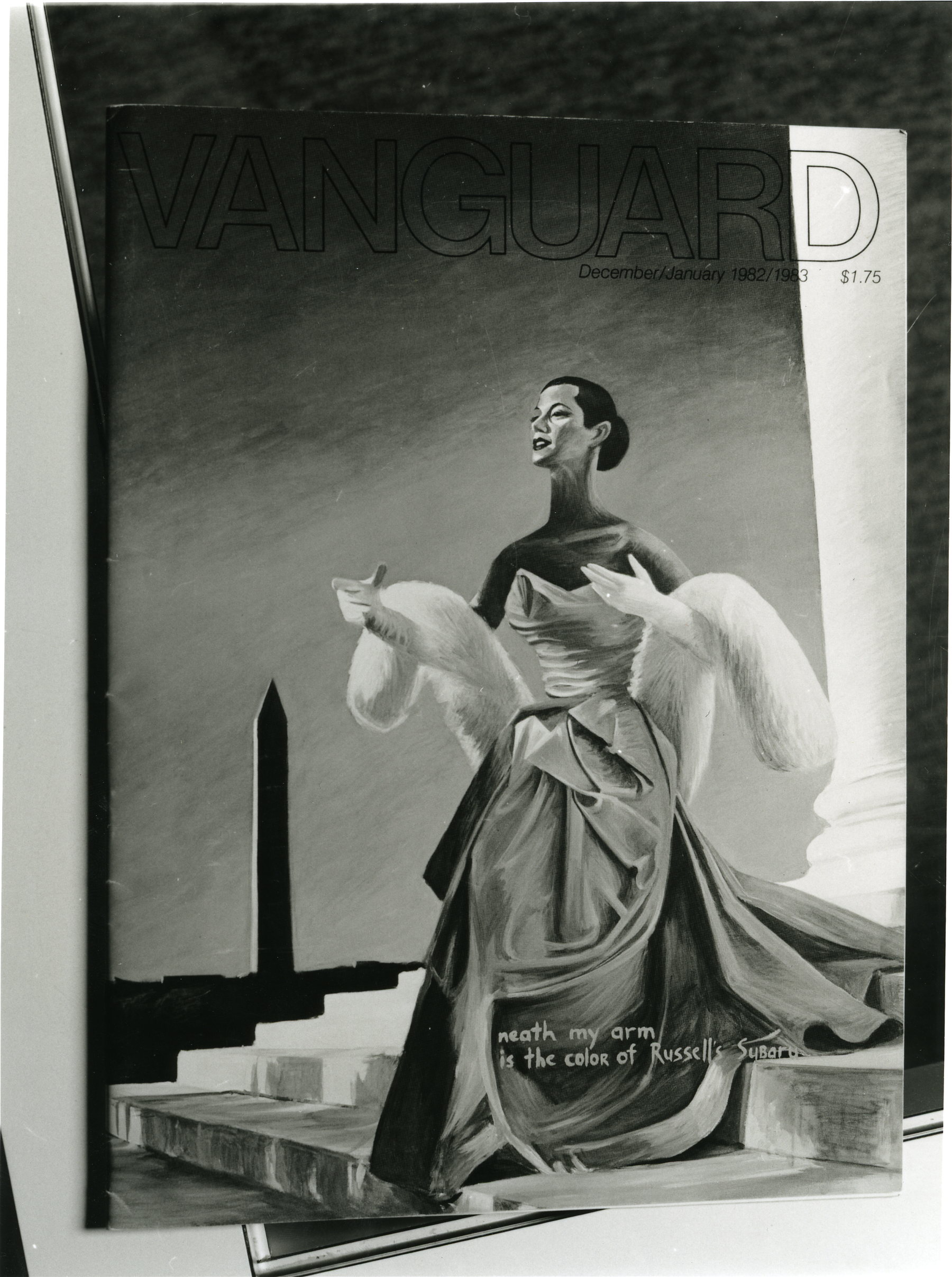
For John Mays of The Globe and Mail, Monumenta was ‘promising’ but also ‘haunted [by] an invisible ghost’ of abstraction, (vii)as well as a second ghost,‘video and performance.’ Besides ghosts, he mentions only painters in the review and withholds both endorsement and condemnation. There were also reviews in the Toronto Star and Vanguard magazine. It was nice to be noticed. Then we went back to work, with new art ideas and an energetic, confident spirit. That period ended with the publication of Philip Monk’s ‘Axes of Difference,’ which imported to the Toronto context argumentmade by Benjamin Buchloh in ‘Figures of Authority, Ciphers of Regression: Notes on the Return to Representation in European Painting.’
Unlike in Buchloh’s Germany, the artists of Monumenta were neither returning to representation nor ‘regressing’ to recoup the supposed authority of a nationalistic painting history. Instead, we were abandoning further work to continue the modernist dream of progress, the rule of abstraction, and the values of media specificity. We knew these things didn’t work anymore. We were young, and for the first time discovering images in our artwork. This representational turn was about refreshing art, renewing possibility and expanding its limits. It was not a conservative re-entrenchment.
In our naivety, Philip seized an opportunity. Cleaving along lines of gender, he used an iconographic schema to outline certain political tendencies he perceived in others and me. ‘Axes’ clobbered my youthful ideal of an idiosyncratic, anarchistic Toronto art scene. Women were set against men, photographers against painters, conceptualists against expressionists, and friends against friends. The co-operative collaboration and community I imagined was chopped into a hierarchy, a new arrangement of authority that would benefit Philip over the next two decades in his work as curator at the Art Gallery of Ontario and Powerplant. Though YYZ Monumenta was a model for larger artist-organized concept shows later in the decade like Chromaliving and New City of Sculpture, and by extension the numerous Toronto art co-ops, collectives and warehouse shows that came after, the aesthetic and conceptual diversity that briefly flourished in Toronto after Monumenta was perhaps never regained.
After Monumenta, I continued to work on my art and other local projects. In1992, with a solo show scheduled at White Columns in New York, I packed whatever possessions I could hide behind my paintings into a rented van and left Toronto. The rest of them were stuffed into a Dupont St. storage unit. I always intended to retrieve them but years in New York became a decade, then almost two. When I finally returned to Toronto, my things were exactly where I’d left them. Dusty and strangely worn—by time, not use—they seemed like a secret shrine, or, better yet, a Monumomento mori.
i OCA is the Ontario College of Art, now OCAD University. Roy Ascott was President of OCA from 1971- 72. For more on Ascott, see: http://canadianart.ca/features/roy-ascott/ (March 21, 2016).
ii For more on the Diodes, see: Worth, Liz. Treat Me Like Dirt: An Oral History of Punk in Toronto and Beyond 1977-1981. ECW Press; Toronto; 2011.
iii The founders of YYZ in 1979 were: David Clarkson, Stan Dennison, Brian Kipping, Matt Harley, Elizabeth MacKenzie, John MacKinnon, Kim Todd, Joanne Tod and George Whiteside,.
iv The Monumenta artists (listed on black and white exhibition posters designed by Dyan Marie) are: Shelagh Alexander, David Anderson, Jim Anderson, Steve Andrews, Richard Banks, Brian Boigon, Robert Bowers, John Brown, David Buchan, Brian Burnett, Jane Byers, David Cheung, Pauline Choi, David Clarkson, Anne Marie Cobbold , Stephan Cruise, Cathey Daley, Marc Deguerre, Stan Denniston, Judith Doyle, Peter Dykhuis, Andy Fabo, Robert Flack, Rebecca Garrett, General Idea, Oliver Girling, Sybil Goldstein, Brian Groombridge, Janice Gurney, Matt Harley, Simon Harwood, Jack Jeffery, Patrick Jenkins, Nancy Johnson, Rae Johnson, Brian Kipping, Douglas Kirton, Martin Klug, Kim Kossi, Colin Lockhead, Elizabeth MacKenzie, Dyan Marie, H.P. Marti, John Massey, John McEwen, John McKinnon, Michael Merrill, Bernie Miller, Christian Morrison, Alex Neuman, David Palmer, Lee Paquette, Andy Patton, Beaty Popescu, Ed Radford, Chris Reed, Jayce Salloum, Brian Scott, John Scott, Caroline Simmons, Chris Ann Stathacos, Yana Sterbak, Joanne Tod, Kim Tomczak, Rene Van Halm, Lorne Wagman, Douglas Walker, George Whiteside, Robert Wiens, Tony Wilson, and Wendy Wortzman.
v Jamie Lyons, Peter Hill, Michael Balfe, Milt Jewell, and Robert McNeally were also associated. vi TIFF was then ‘The Festival of Festivals.’ My cousin, Wayne Clarkson was the Director.
vii That we “neglected, attacked… like Albania” [!] Mays, John Bentley. “Monumenta: promising but haunted.” The Globe and Mail. Saturday, September 11, 1982: p. E11.