

“The purpose of art is to make the invisible visible.” (Paul Klee)
I started writing this essay on a wooden table marked with the embossed staccato of pen tips, which had scarred the visible rings like a silent, secret tapestry. Had I traced these markings to sheet music they could have been played, possibly revealing something deeper, more profound. I wonder, how much of what is so close to us remains unseen? Early on we learn that everything is a certain way, a particular colour; the ocean is blue, the sky is blue, the sun is yellow–when in fact, the former two are clear, and the latter is a giant star radiating white light.
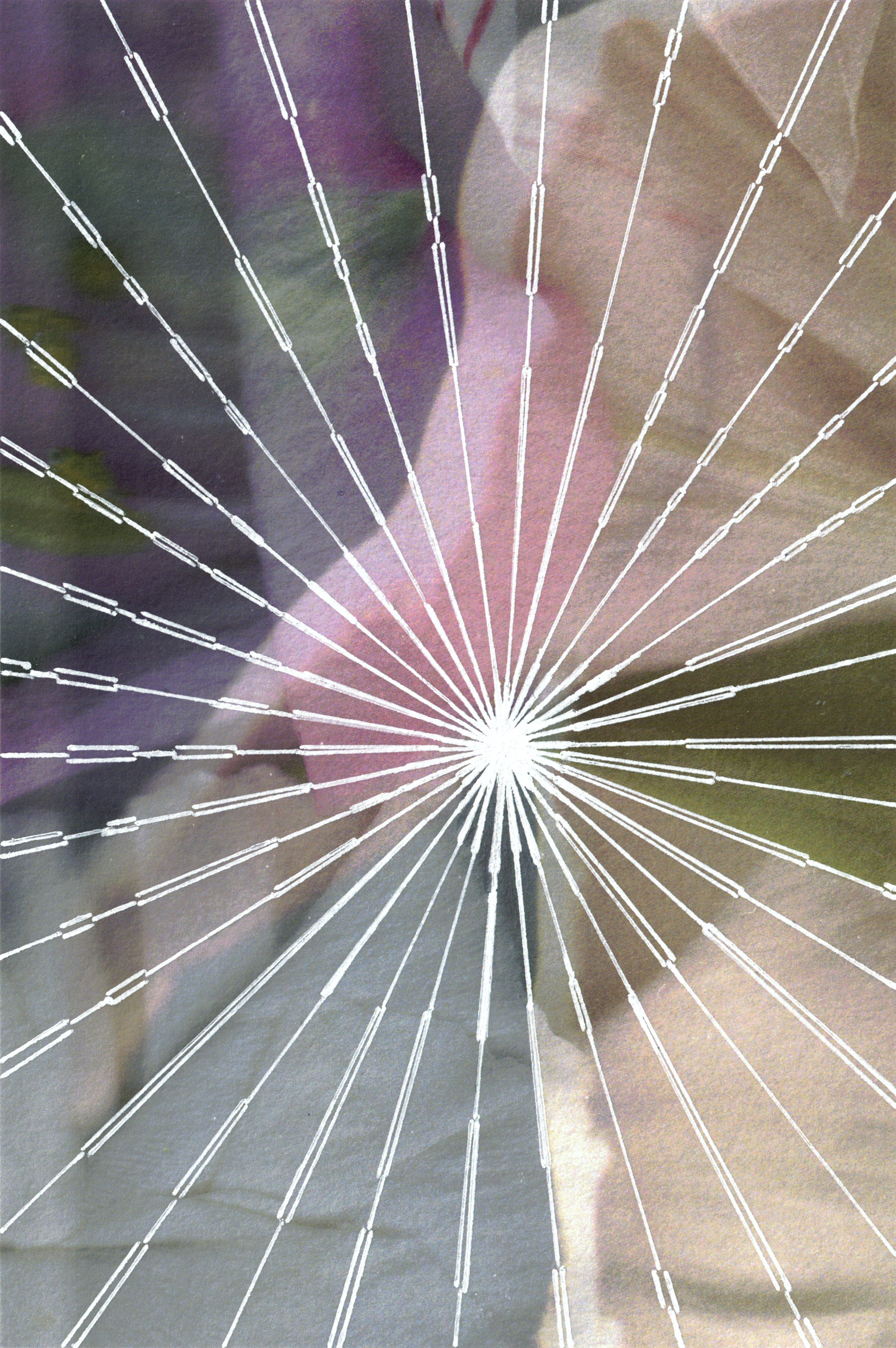
I wonder how the quiet expanse of the work in The distance of nearness holds evidence of mysteries we have yet to unveil. In the work of Susy Oliveira and Sasha Pierce, everything is in a state of becoming. Photos are becoming sculptures, paintings are becoming collages, are becoming photos, are becoming installations. Working both individually and collaboratively for this exhibition, each demonstrates a keen awareness of their mediums, and while their individual practices vary, there is significant overlap. Investigating within the material, each questions perception and purpose, creating physical manifestations of what it feels like to hold, in space and time, the capacity for discovery.
Oliveira’s interdisciplinary work folds together the intelligence of photography with sculpture and collage. Her work, through multiple modes of assemblage, warps the two-dimensional and pushes the three-dimensional, bending objects into the fourth dimension of time. What lies in the fibrous inner layer of a photograph? Somewhere, in the unlikely valleys and peaks of the image, Oliveira reveals things which before were invisible in the ubiquity of our assumptions of three dimensionality and it’s corresponding worldview. Generations of us raised in anthropocenic isolation, approach three-dimensional space, not as relational, but as surmountable. Most of the time, we don’t even see what surrounds us, a phenomenon referred to as peripheral blur or even more starkly observed as Troxler’s fading. In her collages and sculptural works, the image appears to peel, and all of a sudden you are witness to something unexpected. Warping and layering images, as with film stills or photo negatives, becomes a way to conflate presence, expand and refract time.
Similar to Oliveira, Pierce’s paintings push the boundary of their dimensionality, carrying the perspectival weight of the three-dimensional. Patterns, colours, and incisions are a working framework. In Pierce’s work, the paint becomes a kind of vortex. Radiating outwards, one might see gradient skies reflected by broken windows, a kaleidoscope, a butterfly wing as it leaves the chrysalis. I wonder, as with watercolour paint, what chemicals therein make an image? I question how close photo documents and painted objects are to our own physicality. Paint, as an alive medium, means these radiating fractures are pulsing with an energy imperceptible. Sometimes things move, contradictorily, so slowly they become unobservable to the naked eye. Just as the moon’s gravitational pull causes the tides, it also creates earth tides which make the ground rise and fall twice a day by up to 55 centimeters (National Geographic; National Oceanic and Atmospheric Administration). In fact, nothing in the universe is ever at rest, Pierce’s watercolours are actually moving at a speed of roughly 1,180 km/h (Journal of Young Investigators).
Incredible things can happen when we question the nature of reality and perception. In 2024, a Japanese boy, Jo Nagai, wondered if the Asian swallowtail butterflies he was raising remembered him. Through a simple experiment using lavender, he was able to prove that not only did his butterflies remember him after their metamorphosis, but their offspring had also been born with a memory of him (Taggart). This study and other studies using moths and mice, have effectively proven the existence of epigenetics and inherited gene transcription. If we were to conflate human and animal distinctions, empirical data is emerging on epigenetic inheritance in mammals, and how, “environmental information may be inherited transgenerationally at behavioural, neuroanatomical and epigenetic levels” (Dias & Ressler, 1). What form does an image take when it transforms into code that transcends generations? What memory spans our cretin wings? We carry the history of our ancestors before us, imperceptible, yet in our cells.
One can only imagine how global events are changing us from the inside out as we enter a new axial age (Gardels; Scharmer). As the trauma of the contemporary world becomes manifest, possible alterations in the structure and function of our nervous systems could be taking place. Responding to environmental stimuli, “is crucial to the survival of organisms” (Dias & Ressler, 1) and reflecting on the various ways that artists are exhibiting awareness and unifying against these rapid shifts is important. In the case of Oliveira and Pierce, their work reflects one form of resilience in collaboration necessary for future building. In The distance of nearness Oliveira and Pierce demonstrate what can happen when two artists suspend the boundary of the individual. Through mutual respect and joint care, their collaborative work achieves unity without sacrificing the strength of either voice. The action of collaboration becomes a salve for unsure times.
Responses, individual and collective, can be significant in their impact despite being difficult to notice at first. Oliveira often uses vintage soft-porn images of men, subversively made small and layered in botanicals—an act which ultimately decenters the masculine, neutralizes it, and returns these men, nude, to the environment. For Pierce, meditation is a cornerstone of her day-to-day, which gives greater meaning to the presence of triangles in her work, symbolic of the unification of body, mind, and spirit. These are examples of individual defiance and resilience which carry the potential for collective expansion. In the current attention economy, any behavior which forces self-reflection and the anti-monetization of time are radical acts. In their own subtle ways, Oliveira and Pierce reveal a refracting and entangling of time, distorting it beyond linear definition.
Recently, physicists have proven that actions in the present can change the past, or that the past and the future are in fact the same, as physics does not distinguish between them (Rayne). This is known as retrocausality, and is driven by new findings in quantum mechanics (Ferreira). Research on retrocausality, quantum entanglements, and time refraction are altering everything we thought we knew about time. Time, something that we govern our lives by, also, so far from comprehension. It is possible it is neither linear, nor circadian, nor real. How can this be, when, “everything from light and sound to weather and biology operate on the principle of measurable periodicity” (O’Malley, 587). There is, in fact, no consensus among physicists that the fourth dimension has any physical form, as an axis of time, or if it does it is unknown, leaving only speculation of its possible shape(s) and properties. Maybe, as with the ocean, the sky, and the sun, its physical form is dependent on the limits of the visible light spectrum. In other words, perhaps we simply haven’t looked close enough.
The unsounded compositions of punctured wood, the rise and fall of earth tides, evidence of the refraction of time, and the proof of epigenetics in butterflies, is unnoticed by most. There is so much in this world that we can ostensibly “see”, that we cannot see at all. As our bodies quietly transform and change from within us, the mechanisms, the code by which we will ultimately move through future worlds, can we ask ourselves—how can we, as part of a collective whole, move with purpose into the future? What offerings do we have? Self-agency is possible. We can be part of our adaptation as active participants, as a force which collectively embraces, with compassion, everything in its path—past and present and future. The distance of nearness is an exhibition which is representative of the ways in which things can be so close, and yet still be unknowable. It is an exhibition that begins to unravel the action of seeing as something that is critical, especially now, as more than ever before, our humanity, our understanding of the world and the systems that govern it, requires a second look and radical metamorphosis.
NOTES
Notes
Dias, Brian G, and Kerry J Ressler. “Parental Olfactory Experience Influences Behavior and Neural Structure in Subsequent Generations.” Nature Neuroscience, vol. 17, no. 1, Dec. 2013, pp. 89–96, https://doi.org/10.1038/nn.3594. Accessed 18 July 2026.
Ferreira, Becky. “A Growing Number of Scientists Are Convinced the Future Influences the Past.” VICE, 16 Mar. 2023, https://www.vice.com/en/article/a-growing-number-of-scientists-are-convinced-the-future-influences-the-past/. Accessed 2 Sept. 2026.
Gardels, Nathan. “The New Axial Age.” Noema, 17 June 2020, https://www.noemamag.com/the-new-axial-age/. Accessed 1 July. 2026.
“How Fast Are You Moving When Sitting Still?” Journal of Young Investigators, 10 Nov. 2007, https://www.jyi.org/2007-november/2007/11/10/how-fast-are-you-moving-when-sitting-still. Accessed 10 Aug. 2026.
Mendonça, J. T., et al. “Quantum Theory of Time Refraction.” Physical Review A, vol. 62, no. 3, American Physical Society (APS), Aug. 2000, https://doi.org/10.1103/physreva.62.033805.
National Geographic. “Cause and Effect: Tides | National Geographic Society.” Education.Nationalgeographic.Org, 8 May 2023, https://education.nationalgeographic.org/resource/cause-effect-tides/. Accessed 20 Aug. 2026.
National Oceanic and Atmospheric Administration. “Frequency of Tides – The Lunar Day – Tides and Water Levels: NOAA’s National Ocean Service Education.” Noaa.Gov, 2019, https://oceanservice.noaa.gov/education/tutorial_tides/tides05_lunarday.html. Accessed 2 Sept. 2026.
O’Malley, Bert W. “The ‘Fourth Dimension’ of Gene Transcription.” Molecular Endocrinology (Baltimore, Md.), vol. 23, no. 5, May 2009, pp. 587–89, https://doi.org/10.1210/me.2009-0015. PubMed Central. Accessed 18 July 2026.
Rayne, Elizabeth. “Scientists Say There’s No Difference Between the Past and the Future.” Popular Mechanics, 21 Feb. 2025, https://www.popularmechanics.com/science/a63840672/no-difference-past-future/. Accessed 2 Sept. 2026.
Scharmer, Otto. “We May Be Entering A Second Axial Age.” Noema, 12 May 2026, https://www.noemamag.com/we-may-be-entering-a-second-axial-age/. Accessed 15 Sept. 2026.
Taggart, Emma. “10-Year-Old Discovers That Butterfly Memories Survive Metamorphosis and Can Be Inherited.” My Modern Met, 31 July 2026, https://mymodernmet.com/jo-nagai-butterfly-study/. Accessed 29 Aug. 2026.
“Understand the Phenomenon of the Yellow Color Sun and the Blue Sky.” Encyclopedia Britannica, 2020, https://www.britannica.com/video/yellow-Sun-sky-blue-light-colours-air/-204059. Accessed 2 Sept. 2026.
SARAH SANDS PHILLIPS (b. Tsí Tkaròn:to, Canada) is a Red River Métis/British-Irish artist and poet. She holds an MFA from the Ruskin School of Art at the University of Oxford (2019) and has exhibited in Canada and internationally. Her writing has appeared in Channel; Splinter; tba: Journal of Art, Media, and Visual Culture; and Public, among others. She is currently based in Japan.
SUSY OLIVEIRA & SASHA PIERCE have been friends since 2005, this is their first collaborative exhibition.
Susy Oliveira is a Toronto based artist working in photography, sculpture and collage. Selected exhibitions include shows at Andrew Rafacz Gallery, Chicago; Open Studio, Toronto; The Hole, NYC; Museum of Contemporary Canadian Art, Toronto; SAW Gallery, Ottawa; and PLATFORM, Winnipeg.
Sasha Pierce is a Toronto based artist working in painting and collage. Selected exhibitions include Zalucky Contemporary, Toronto; Richard Heller Gallery, Santa Monica; Jessica Bradley Gallery, Toronto; Museum of Contemporary Canadian Art, Toronto; and ACME., Los Angeles. Sasha Pierce is represented by Richard Heller Gallery, Santa Monica. Sasha Pierce would like to thank Superframe for their Framing Fund and the Ontario Arts Council.