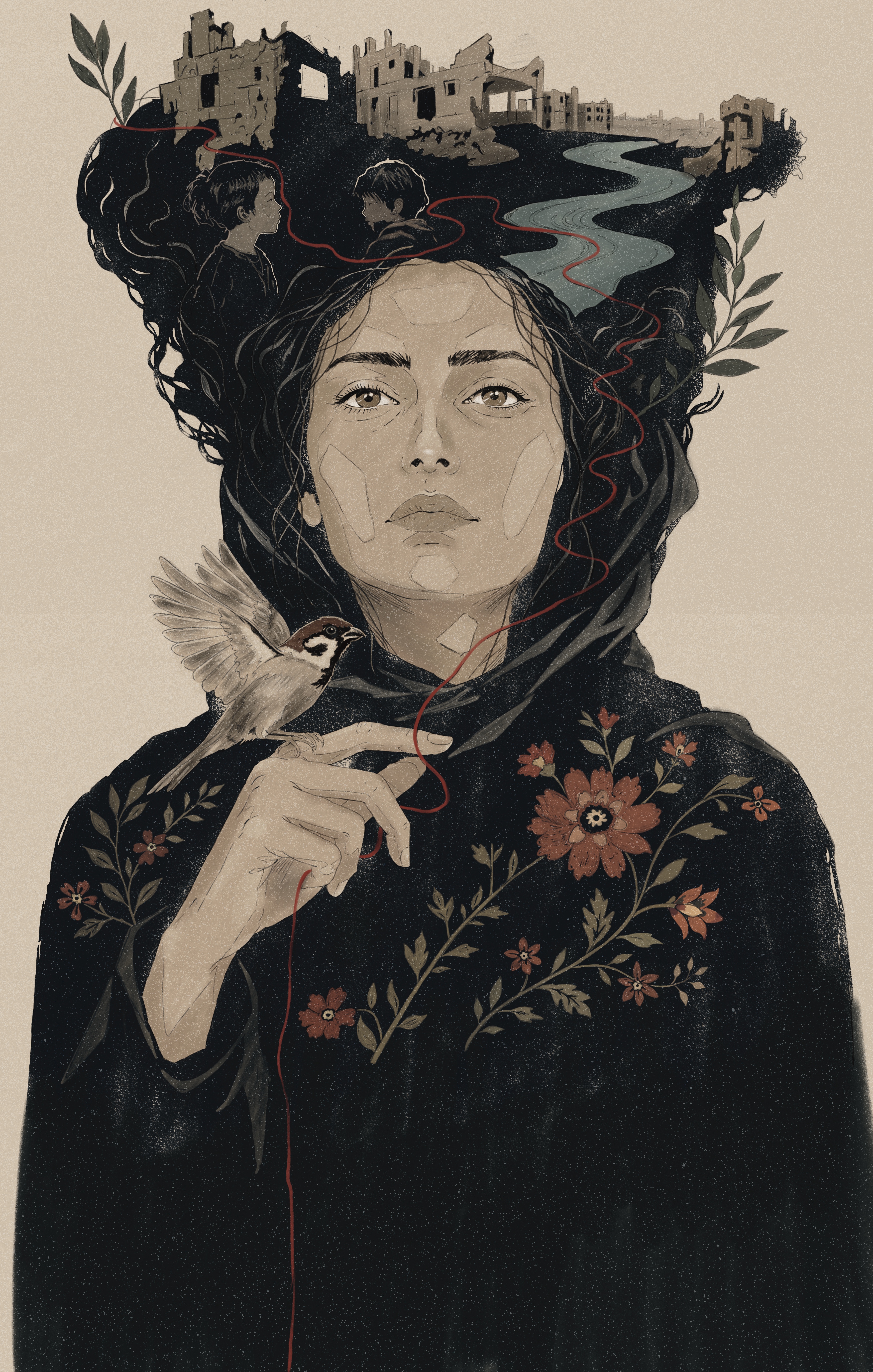


The mural Tread of Memory explores themes of loss, enforced disappearance, memory, resilience, and the enduring human need to seek truth. For more than a decade, much of my work in visual storytelling has been connected to human rights, displacement, detention, and the experiences of survivors and families living with absence.
Trough documentary work, drawing, design, and visual communication, Alhariry has engaged with personal testimonies and stories that are often difficult to translate into images. This mural grows naturally out of that experience, while giving him space to approach these themes through a more personal and poetic visual language.
Alhariry is particularly drawn to what it means for people to find the strength to continue with their lives while the fate of someone they love remains unknown. Enforced disappearance creates a distinct form of loss: memory endures, questions remain open, and people continue their lives while carrying that uncertainty. Behind every missing person are families and individuals carrying stories that can remain for years within their inner lives, homes, memories, photographs, conversations, and silence.
With this mural, Alhariry wants to bring part of these experiences into a shared public space. He wants the work to create a moment in which private memory becomes part of a broader public dialogue, allowing stories of absence to emerge from isolation, become visible and heard, and reach people beyond those who have lived these experiences directly. At the same time, resilience and hope are central to the mural. At the center of the work, a woman carries within her an inner landscape of memory in which fragments of place, children, traces of destruction, a river, plants, and a bird overlap. A red thread moves through these elements, linking people, places, memories, and what remains unresolved or without closure. the growing plants, the bird, the flowing river, and the thread that continues its path all suggest that memory is not only about what has been lost, but also about what endures: connection, survival, the search for truth, and the ability to continue living while preserving the presence of those who are absent.
For Alhariry, realizing this work as a mural in a public space carries particular significance because it moves these stories from the private realm of memory into a physical presence within the city. It also allows people from different backgrounds and experiences to encounter these stories and find their own relationship to themes of loss, memory, hope, and belonging.
This project is part of the STEPS Public Art Residency Program and is supported by TD Bank Group through the TD Ready Commitment.
Artist Bio
Adeeb Alhariry
Adeeb Alhariry is a Syrian visual storyteller and multimedia artist based in Toronto, Canada. He holds a Bachelor’s degree in Visual Communication from the Faculty of Fine Arts at Damascus University. His practice brings together illustration, animation, motion graphics, and mixed media, with a focus on the capacity of images to carry memory, emotion, and lived experience.
Alhariry’s artistic voice has been shaped through years of working alongside Syrian civil society, human rights, and stabilization organizations. This background has informed a practice deeply engaged with memory, identity, displacement, and absence. Through his work, he explores how personal stories and collective histories can be transformed into visual narratives that transcend distance, language, and place.
His visual language draws on testimonies, the memories of families who have experienced loss, and traditional Syrian visual references. He approaches image-making not merely as decoration, but as a form of communication and remembrance—a space where grief, resilience, and the hope for justice can coexist.
In his current public art practice, Alhariry is especially interested in conveying the experiences of women, survivors of detention, and communities affected by enforced disappearance. Moving between digital and handmade processes, he creates layered works that invite viewers to reflect on stories that are often overlooked, silenced, or left incomplete.