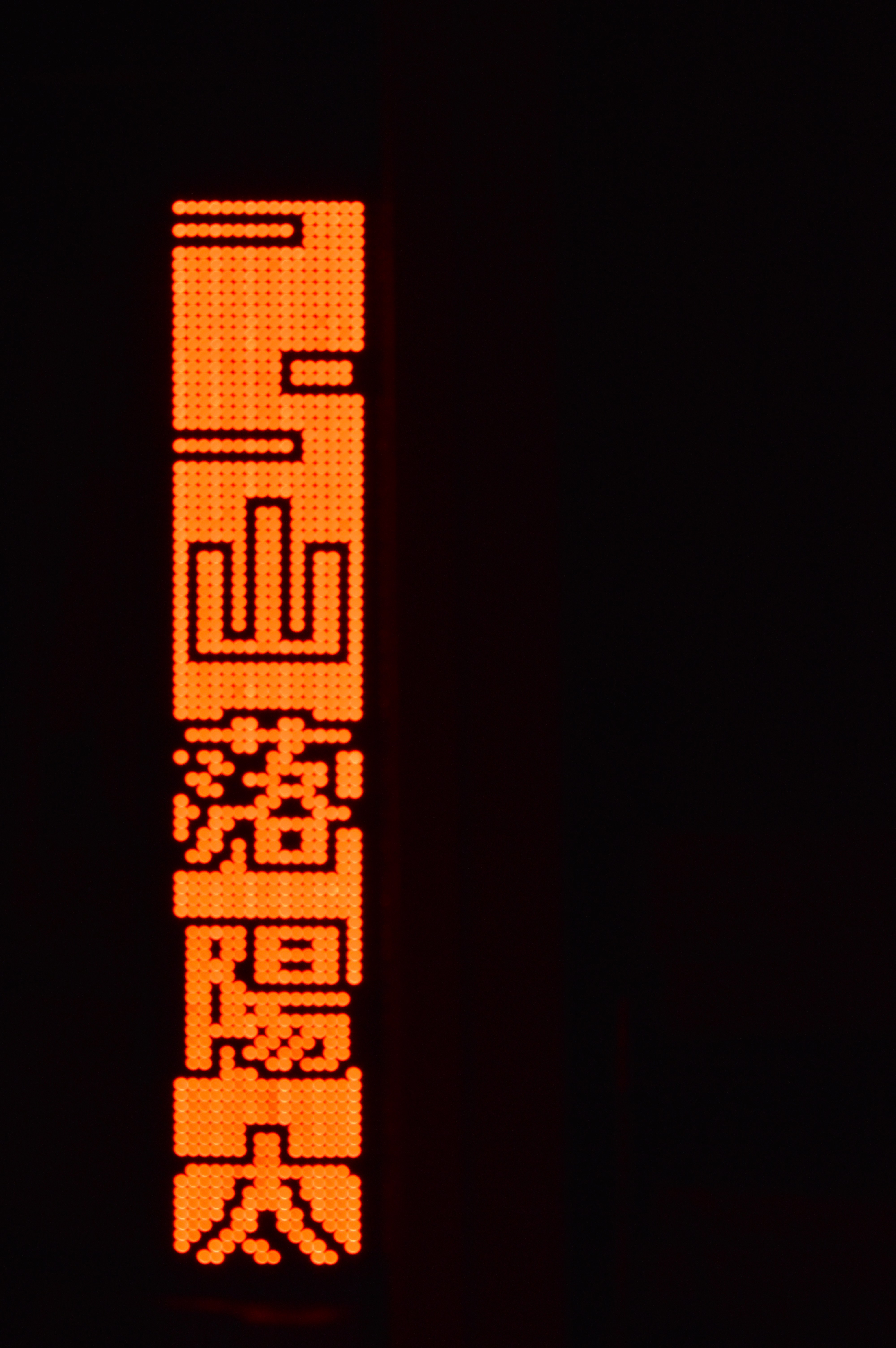


Near the end of Winter, I visited Lan in their studio to see the LED signs. It was the kind of cold that makes you cough, outside, hard ground that even the start of roots can’t cut through. Hard crust of salt on the sidewalks. Every year the city puts down enough salt on the sidewalks and streets that Lake Ontario has started to grow saltwater species of seaweed. Human-made and natural and incidental circumstances meet.
I told Lan I realized on my way over that the last time I’d gone to their studio had been a year and a half ago, close to the end of Spring. Human-made and natural and incidental circumstances meet and that time, it meant the snake plant they keep in their studio had grown a flower.
Glowing in any light, pale green, looking almost neon from the smooth gloss of its petals, stamens out at odd angles, a spray of stamens like fireworks in every direction. And green. The whole flower, green, and surprising me, it did not smell like green apples, but it did smell exactly like Dawn-brand green apple-scented dish soap. Human-made and natural and incidental circumstances touch each other in interesting ways.
A year and a half ago, close to the end of Spring, it was green, outside and in Lan’s studio, everywhere, late-May and new leaves, after the lilacs. We have that to look forward to again. But for now: red. Lan’s studio isn’t a big room and they’d set up the LED signs on every wall to face each other. I could see it from the hall, the whole room glowed red.
Behind the LED signs and around them, Lan’s paintings, all in red, white backgrounds, a lighter shade of red, the images, easy to recognize anyway. Lan took it as good feedback: it showed they’d been using contrasts of light and dark well, that the colours weren’t all that let you read the shapes.
Leaves growing up a wall, a running-man exit sign, a pixelated angel.
Lan said they were finding what made art feel playful again. They said they wanted the opening to feel like a party. One sign, they thought, should move faster.
Over time what was red in the light faded and it was orange. Lan put on a recording they’d taken of the sound of rainfall in Taiwan. They had wanted it playing on loop with the signs in the show. Looking out the window and across the street, an empty sidewalk and an empty park bench in front of a concrete high-rise building all washed in an impossible green light, I believed that it was the sound of rain on the recording. In the red light that had faded orange I could only hear the last of a bonfire, hot. In the moving lights, words crawling and reaching backwards to memories and material impressions the words can brush against, the sound was mechanical, I believed the sound had something to do with the words and the light machines that were making them.
Human-made and natural and incidental circumstances move with one another and over one another and bleed together.
A streetlamp and the moon turning the street outside turquoise and green and blue like an aquarium lamp. A painting of a pixelated angel. The light on the printer beside the window, the bluest light I had ever seen.
YYZ is a larger space than Lan’s studio. The red and orange lights stay touching the LEDs that make them, elsewhere the room and its shadows keep their own colours. The hall outside the gallery keeps its own colours. The floors are older than most of the walls and both of them carry memories from older installations, paintings or photographs or LED signs or factory machinery. With the ceiling lights off the only memories you see are the ones that the crawling and scrolling words move towards, move to touch.
Even when the lights are on, some memories are meant to hide, a spot where the texture of the spackle doesn’t match the texture of the wall, or the paint is older and the white is a different white, a blue plastic wall anchor left in the mortar between the bricks. Burns and stains on the hardwood contribute, left behind from factory machinery, to heritage, the Victorian Toronto industrial architectural style. All past installations. Tunnels under the building and under the street around it that connected abandoned sections of the PATH network. Usually, it’s easier to leave installations up than take them down. Coming near to the building and closer to the hardware store, but on no maps touching either, rivers up from the lake that wasn’t always so far, farther underground now than the PATH network.
When it rains you can hear the rivers in the storm sewers. Close your eyes and hear a mechanical tick, the last of a bonfire. Travel across the sea and end up somewhere that’s the same. End up somewhere so different you can’t remember where you’d been before. Human-made and natural and incidental circumstances move together in layers and memories. There isn’t enough separation to feel like the difference is worth maintaining.
By comparison everything outside of Lan’s studio was green. Anything blue was alarming. Red and orange lost interest when they didn’t come from LEDs. When winter’s ending everything green is a novelty and a promise and a memory. The red from the LED signs reminded me that I had been missing when everything was green, when everything would turn green again. They reminded me I had been missing the pixelated angel, when before I didn’t know that I would recognize it at all.
Snake plants are easy plants to care for. They don’t need a lot of light. They easily keep the variegation on their leaves and they grow slowly. They don’t show it if you forget to water them sometimes or never feed them. That they’re easy to care for means they’re popular as houseplants and in landscaping. Snake plants that live around people mostly never grow flowers. If Lan hadn’t told me, I wouldn’t have known that they could.
Anda Ali works in facilities, in social services, and outside.